
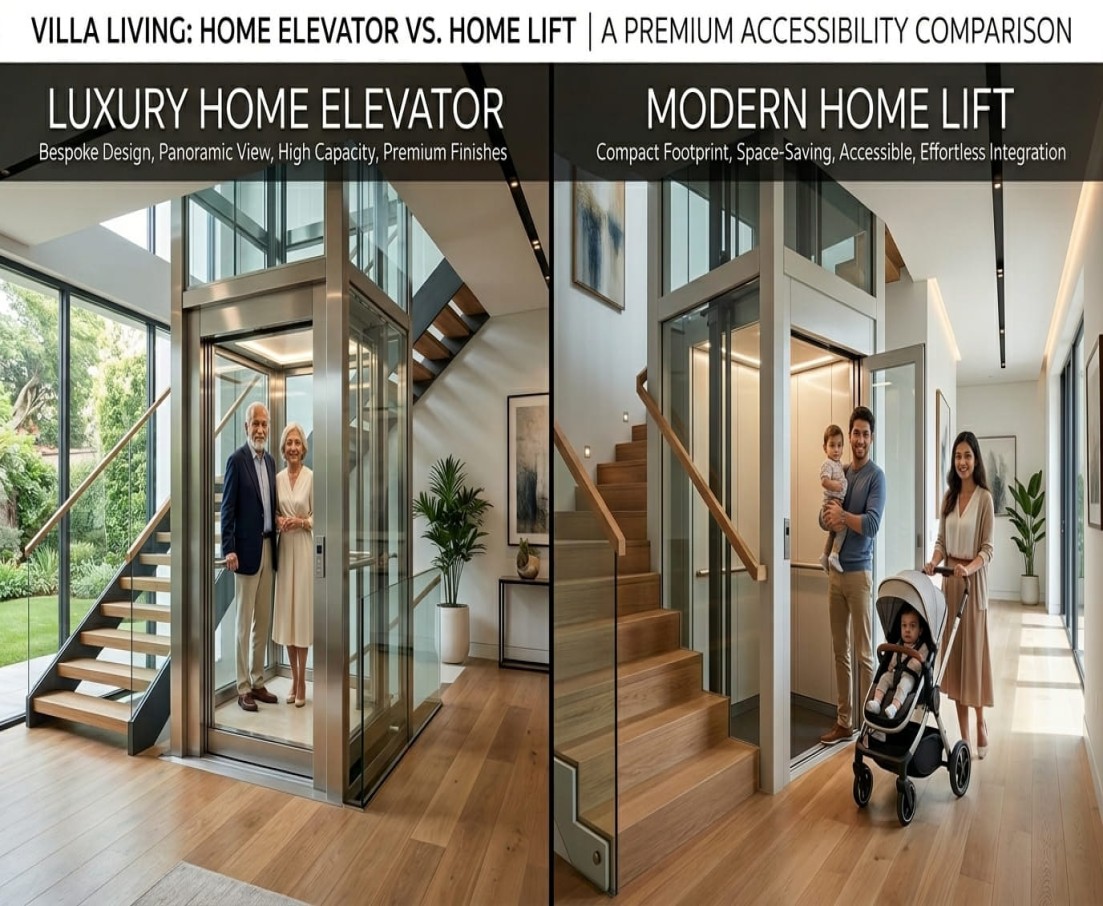
If you've started researching vertical mobility options for your home, you've probably noticed "home lift" and "home elevator" used interchangeably — sometimes even on the same product page. They're often the same thing marketed differently, but there are real technical distinctions worth understanding before you buy.
Quick Answer
In most markets, "home lift" and "home elevator" describe the same category of small-capacity, low-speed residential lift. Where a real difference exists, it's usually in drive mechanism (hydraulic/pneumatic vs. traction) and structural requirements — not in the name itself. The terminology split is more pronounced in some regions (UK/India tend to say "home lift," US listings often say "home elevator") than in engineering reality.
The Short Version: It's Mostly a Naming Convention
Globally, "home lift" is the more common term in the UK, India, Australia, and much of Asia. "Home elevator" is the standard term in the US and Canada. Manufacturers serving multiple regions often use both terms on the same product to capture search traffic and match local buyer vocabulary — which is exactly why you'll see them used interchangeably even within one brand's catalogue.
That said, when people draw a real technical line between the two terms, it usually comes down to three things: drive type, structural footprint, and intended use case. Let's go through each.
Drive Mechanism: Where the Real Differences Live
Residential vertical lifts are built on one of a few core drive systems. This is where genuine product differences show up, regardless of what the listing calls the unit.
How It Moves
• Typical Use
• Hydraulic
A hydraulic pump pushes the cabin up via a piston; gravity and a valve control descent
Common in budget home lifts; needs a small machine room or cabinet
• Pneumatic (Vacuum)
Air pressure differential raises and lowers a sealed cylindrical cabin
Retrofit installations; no pit or machine room needed
• Traction (Geared/Gearless)
An electric motor drives a cable-and-pulley system, similar to commercial elevators scaled down
Premium home elevators; smoother ride, higher travel height
Screw & Nut
The cabin climbs a fixed screw shaft via a motor-driven nut mechanism
Compact installations with limited overhead clearance
This is the most useful axis to compare on, because it actually changes what you can install and where. A pneumatic lift, for example, can often go into an existing home without major structural work — but it usually carries only 1–2 passengers and has a lower weight limit than a hydraulic or traction system.
Structural & Space Requirements
Whatever the unit is called, here's what tends to differ by drive type and capacity class:
• Factor
• Compact Home Lift
• Full Home Elevator
• Pit Depth
• Often none to 100mm
• 150mm – 300mm+ typical
• Overhead Clearance
• As low as 2200mm
• 2800mm – 3200mm+ typical
Machine Room
• Usually none (self-contained unit)
• Sometimes a small dedicated space
• Capacity
• 1–3 persons / up to ~250 kg
• 3–6 persons / up to ~450 kg
• Floors Served
• Typically 2–3
• Typically 2–5
• Retrofit-Friendly
• High
Moderate (more civil work)
Note on numbers: these ranges reflect common configurations across the residential lift industry generally — actual figures vary by manufacturer and model. Always confirm exact pit depth, overhead clearance, and load capacity with the specific supplier before finalizing your home's structural drawings.
Ride Experience & Noise
This is where buyers notice the difference most directly, even if they never learn the technical term for what's driving the cabin.
Hydraulic / Pneumatic Lifts
✓Lower upfront cost
✓Minimal civil work for retrofits
✕Slower typical speed (0.15–0.3 m/s)
✕Some motor noise during operation
✕Hydraulic fluid needs occasional servicing
Traction-Drive Home Elevators
✓Smoother acceleration and stops
✓Quieter operation, no hydraulic fluid
✓Generally higher weight capacity
✕Higher upfront cost
✕More structural planning required
Cost: What Actually Drives the Price Difference
Across the industry, price is driven far more by drive type, capacity, number of floors, and finish than by whether a brand calls its product a "lift" or an "elevator." As a rough shape of the market (not a quote):
Compact pneumatic/hydraulic units for 2-floor homes sit at the lower end of the residential lift price range.
Traction-drive systems with higher capacity and more floors served sit meaningfully higher.
Custom cabin finishes (glass, designer panels, wood paneling) add cost on top of the base mechanism, regardless of drive type.
Because pricing varies by region, currency, and current material costs, the most reliable way to get an accurate number is a quote based on your actual floor count, shaft space, and finish preferences — general published price ranges online are frequently outdated or don't reflect import/installation costs in your specific city.
So, Which Term Should Guide Your Decision?
Honestly — neither term alone tells you enough to make a buying decision. Instead of asking "should I get a lift or an elevator," ask these questions:
• Is this a new build or a retrofit?
New construction gives you flexibility on shaft size and pit depth. Retrofits often favor pneumatic or compact hydraulic systems that need minimal structural alteration.
• How many floors and how many passengers at once?
A 2-floor villa with single-occupant use has very different requirements than a 4-floor home that needs to move a wheelchair or a person with a caregiver.
• What's your available shaft or corner space?
Pneumatic lifts can fit in surprisingly tight footprints (under 1 sq. meter in some models); traction systems typically need more planned shaft area.
• Is long-term ride quality or upfront cost the priority?
If this is a forever home and daily-use accessibility matters, a smoother traction-drive system often pays for itself in comfort and lower long-term maintenance.
• Does the unit need to meet accessibility or building code requirements?
If the lift is for a family member with mobility needs, ask the manufacturer directly which models meet your local accessibility code — this changes by country and sometimes by state/region.
•A Word on Terminology and Codes
Building codes and safety standards for small residential lifts vary significantly by country — and sometimes by state or municipality within a country. Some jurisdictions classify "home lifts" under a separate, lighter-touch code than full passenger elevators, with different inspection and certification requirements. Because these regulations are updated periodically and differ by location, don't rely on a blog post (including this one) for code compliance — confirm current requirements with your local building authority or directly with your installer before finalizing plans.
The Bottom Line
"Home lift" and "home elevator" are, in nearly all practical cases, the same product category described with regionally preferred words. The decision that actually matters is which drive mechanism and capacity class fits your home's structure, your family's daily use, and your budget — not which word appears on the brochure.
If you're comparing options, ask any supplier to walk you through drive type, pit/overhead requirements, and capacity side-by-side — that conversation will tell you far more than the product name ever will.
Not sure which configuration fits your home?
Share your floor count and available shaft space — our team will recommend a configuration and send a custom quote.

